Wilson Optix V2 Power Blue 2026 Review
By Andres Jovem · Updated October 7, 2026
A budget teardrop for the improving attacker, with a fiberglass face that forgives a drifting strike, so long as your swing shows up to supply the finish.
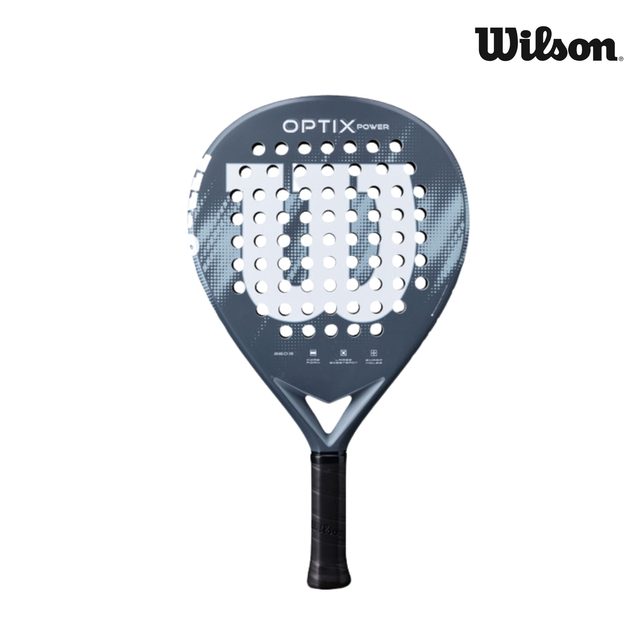
The verdict
The Wilson Optix V2 Power Blue is a teardrop with power in its name, pitched at the intermediate player growing into an attacking game. The shape sits between a round head and a diamond, so the sweet spot rides a little higher than on a control frame without the narrow, demanding zone of a full diamond. A fiberglass face keeps a drifting strike in play. That is the whole pitch, and Wilson keeps the outlay low enough that a club player can afford to grow into it.
What it asks in return is a committed swing. This is a frame for the player who has started to trust an overhead and wants a stick that lets them go for it, and the pace on the smash is mostly yours to bring. If your contact still wanders badly, or your arm is the first thing to fade after a long match, read on before you buy.
The build
A foam core, density unstated
Wilson lists the core as foam and stops there, with no density, so its feel is something you learn by hitting with one. That matters, because core firmness drives how fast the ball leaves and how much of each hit reaches your arm. The parts Wilson does spell out, the face and the frame, are where this racket makes its case.
A fiberglass face that gives a little
The hitting layer is a fiberglass weave, and it bends at contact where a carbon face would hold rigid. That give is what lets a strike that lands off the middle still go roughly where you aimed instead of dying on the frame. The price is snap: on a fast exchange the face lends you less free speed, so more of it comes from your arm.
A teardrop on a carbon-reinforced frame
The mold is a teardrop, and the frame is reinforced with carbon to keep that shape steady when a heavy ball lands on it. A teardrop sets the sweet spot a touch higher than a round head, so an overhead gets a little more reach, while the zone stays wider than a diamond's when your contact drifts. Shops disagree on where the 360g balances, one calling it medium and another high, so pick one up before you count on a heavy head.
How it plays
On the attack, commitment pays
Set your feet under a lob and the Optix rewards you for going all in. The reach it lends up top means a full stroke meets the ball high and sends it deep, and the shot feels like it clears the net with room to spare. The pace, though, tracks your swing: finish the motion and the ball lands with weight, cut it short and it sits up for the other pair to punish. This is a frame that lets you attack, not one that attacks for you.
At the net, listen for the flush hit
There is a clean, low thock when a volley leaves the middle of the bed, and that sound is your cue that the block went where you wanted it. Get your feet turned early and you can redirect pace without a big swing. Let the ball drift in behind you and you meet it late, so the same volley floats and sits up. Early footwork buys you the flush contact, and the frame pays it straight back.
Defending deep, you make the length
Back on the fence under pressure, the giving face is on your side: a stretched block still leaves with a little cushion and finds the court. What the frame will not do is spring the ball out deep for you. A block or a reset goes where your hand puts it. Meet it with a settled contact and the ball sits back at a length. Stab at it and it leaks short. The racket keeps your defense honest, which suits the attacker content to dig for one ball and then step in and swing.
What it does to your arm
The fiberglass face takes some of the sting out of a mishit, and that counts for something. Beyond that, the usual rule holds: once fatigue creeps in, your timing slips, the strike lands off center, and more of the jolt travels into your arm and shoulder. Warm up, keep your feet under the ball, and if your arm is already sore, read the arm question in the FAQ before you buy.
Who it's for (and who should skip it)
Buy it if
- You make your own pace and want a teardrop with enough reach to reward a committed smash.
- You play at the front of the court, chasing the overhead and the volley put-away, and you like a racket that rewards a fully committed swing.
- You want your first attacking shape without a big outlay, and a forgiving face matters more to you than free power.
Look elsewhere if
- Your arm or shoulder is the first thing to fade over a long match. A racket built around the attack is not the safe bet for a sore arm, and a frame sold on comfort will treat you better.
- You are brand new and still building a swing. Wilson aims this one at intermediates, and a round, lighter frame will teach a cleaner contact first.
- You spend more time defending than attacking and want the frame to hand you an easy deep reply off the back wall.
Not sure it's your match? The free 2-minute quiz reads your level, style, and budget and tells you which racket is.
The bottom line
There is no single best racket, only the one that fits your game. The Optix V2 Power Blue fits the improving attacker who wants an attacking teardrop at a starter outlay and can bring the technique to point it where they mean. If that is not quite you, the free two-minute quiz reads your level, style, and budget and puts you in front of the frame that is.
Where to buy
Prices shown in Euro, converted and approximate. You check out in the store's own currency.
Frequently asked
Not really. The Optix V2 Power Blue is a 360g teardrop pitched at intermediates, with an attacking lean that asks for a committed swing, so a true beginner gets more racket than they can use. A rounder, lighter frame will teach a cleaner contact while you learn. Come back to this one once your overhead is grooved.
It leans toward attack, as the name says, though less than a diamond would. The teardrop shape gives an overhead a little more reach than a round frame, and the fiberglass face keeps a mishit in play. Expect the finishing pace to come mostly from you, and any control from your own placement and timing.
It sits at the budget end of the power shelf, which is a big part of why an improving club player should look at it. Check the live price comparison above for the current in-stock figure from our retailers, since it shifts with stock and currency. Few attacking teardrops get you into the shape for so little.
Wilson builds it on a foam core behind a fiberglass weave face, all in a carbon-reinforced frame. The fiberglass flexes at contact and keeps an off-center hit in play, while the carbon in the frame holds the teardrop steady.
That comes down to a spec Wilson does not publish: the core's density, which decides most of the shock your arm takes. The fiberglass face is gentler on a mishit than stiff carbon, so an off-center hit stings less, but if your arm is already sensitive, hit with one before you buy.


The app · free quiz
Not sure which one's you?
Take the free quiz in the app. We'll match a racket to your game, not the other way around.
Find my racketFree quiz. Sign in with email or Google to get your four picks.

Wilson Optix V2 Power Blue 2026 Review
By Andres Jovem · Updated October 7, 2026
A budget teardrop for the improving attacker, with a fiberglass face that forgives a drifting strike, so long as your swing shows up to supply the finish.
The verdict
The Wilson Optix V2 Power Blue is a teardrop with power in its name, pitched at the intermediate player growing into an attacking game. The shape sits between a round head and a diamond, so the sweet spot rides a little higher than on a control frame without the narrow, demanding zone of a full diamond. A fiberglass face keeps a drifting strike in play. That is the whole pitch, and Wilson keeps the outlay low enough that a club player can afford to grow into it.
What it asks in return is a committed swing. This is a frame for the player who has started to trust an overhead and wants a stick that lets them go for it, and the pace on the smash is mostly yours to bring. If your contact still wanders badly, or your arm is the first thing to fade after a long match, read on before you buy.
The build
A foam core, density unstated
Wilson lists the core as foam and stops there, with no density, so its feel is something you learn by hitting with one. That matters, because core firmness drives how fast the ball leaves and how much of each hit reaches your arm. The parts Wilson does spell out, the face and the frame, are where this racket makes its case.
A fiberglass face that gives a little
The hitting layer is a fiberglass weave, and it bends at contact where a carbon face would hold rigid. That give is what lets a strike that lands off the middle still go roughly where you aimed instead of dying on the frame. The price is snap: on a fast exchange the face lends you less free speed, so more of it comes from your arm.
A teardrop on a carbon-reinforced frame
The mold is a teardrop, and the frame is reinforced with carbon to keep that shape steady when a heavy ball lands on it. A teardrop sets the sweet spot a touch higher than a round head, so an overhead gets a little more reach, while the zone stays wider than a diamond's when your contact drifts. Shops disagree on where the 360g balances, one calling it medium and another high, so pick one up before you count on a heavy head.
How it plays
On the attack, commitment pays
Set your feet under a lob and the Optix rewards you for going all in. The reach it lends up top means a full stroke meets the ball high and sends it deep, and the shot feels like it clears the net with room to spare. The pace, though, tracks your swing: finish the motion and the ball lands with weight, cut it short and it sits up for the other pair to punish. This is a frame that lets you attack, not one that attacks for you.
At the net, listen for the flush hit
There is a clean, low thock when a volley leaves the middle of the bed, and that sound is your cue that the block went where you wanted it. Get your feet turned early and you can redirect pace without a big swing. Let the ball drift in behind you and you meet it late, so the same volley floats and sits up. Early footwork buys you the flush contact, and the frame pays it straight back.
Defending deep, you make the length
Back on the fence under pressure, the giving face is on your side: a stretched block still leaves with a little cushion and finds the court. What the frame will not do is spring the ball out deep for you. A block or a reset goes where your hand puts it. Meet it with a settled contact and the ball sits back at a length. Stab at it and it leaks short. The racket keeps your defense honest, which suits the attacker content to dig for one ball and then step in and swing.
What it does to your arm
The fiberglass face takes some of the sting out of a mishit, and that counts for something. Beyond that, the usual rule holds: once fatigue creeps in, your timing slips, the strike lands off center, and more of the jolt travels into your arm and shoulder. Warm up, keep your feet under the ball, and if your arm is already sore, read the arm question in the FAQ before you buy.
Who it's for (and who should skip it)
Buy it if
- You make your own pace and want a teardrop with enough reach to reward a committed smash.
- You play at the front of the court, chasing the overhead and the volley put-away, and you like a racket that rewards a fully committed swing.
- You want your first attacking shape without a big outlay, and a forgiving face matters more to you than free power.
Look elsewhere if
- Your arm or shoulder is the first thing to fade over a long match. A racket built around the attack is not the safe bet for a sore arm, and a frame sold on comfort will treat you better.
- You are brand new and still building a swing. Wilson aims this one at intermediates, and a round, lighter frame will teach a cleaner contact first.
- You spend more time defending than attacking and want the frame to hand you an easy deep reply off the back wall.
Not sure it's your match? The free 2-minute quiz reads your level, style, and budget and tells you which racket is.
The bottom line
There is no single best racket, only the one that fits your game. The Optix V2 Power Blue fits the improving attacker who wants an attacking teardrop at a starter outlay and can bring the technique to point it where they mean. If that is not quite you, the free two-minute quiz reads your level, style, and budget and puts you in front of the frame that is.
Where to buy
Prices shown in Euro, converted and approximate. You check out in the store's own currency.
Frequently asked
Not really. The Optix V2 Power Blue is a 360g teardrop pitched at intermediates, with an attacking lean that asks for a committed swing, so a true beginner gets more racket than they can use. A rounder, lighter frame will teach a cleaner contact while you learn. Come back to this one once your overhead is grooved.
It leans toward attack, as the name says, though less than a diamond would. The teardrop shape gives an overhead a little more reach than a round frame, and the fiberglass face keeps a mishit in play. Expect the finishing pace to come mostly from you, and any control from your own placement and timing.
It sits at the budget end of the power shelf, which is a big part of why an improving club player should look at it. Check the live price comparison above for the current in-stock figure from our retailers, since it shifts with stock and currency. Few attacking teardrops get you into the shape for so little.
Wilson builds it on a foam core behind a fiberglass weave face, all in a carbon-reinforced frame. The fiberglass flexes at contact and keeps an off-center hit in play, while the carbon in the frame holds the teardrop steady.
That comes down to a spec Wilson does not publish: the core's density, which decides most of the shock your arm takes. The fiberglass face is gentler on a mishit than stiff carbon, so an off-center hit stings less, but if your arm is already sensitive, hit with one before you buy.
The app · free quiz
Not sure which one's you?
Take the free quiz in the app. We'll match a racket to your game, not the other way around.
Find my racketFree quiz. Sign in with email or Google to get your four picks.