Starvie Arkos 2026 Review
By Andres Jovem · Updated October 19, 2026
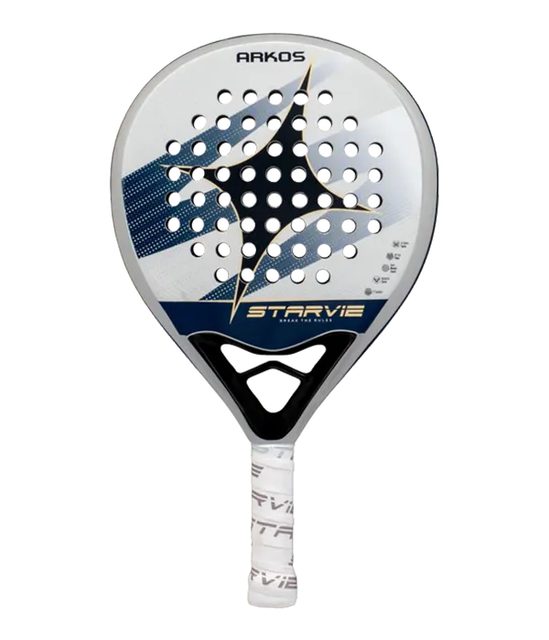
The Starvie Arkos is a soft, round, forgiving frame for a new player, built in Spain with a carbon frame and a spin-ready face at entry money, and one you'll outgrow once your swing arrives.
The verdict
The Starvie Arkos is a starter racket that doesn't feel like a starter racket, and that's the whole pitch. It's round, soft-cored, and light in the head, so the sweet spot sits low and central where a new player actually makes contact, and a mishit still drops in the court instead of flying the fence. What lifts it above the usual first-timer box is the build under the paint: a carbon frame and a rough hitting face, the two parts budget rackets cut first. You get them here for entry money.
This is a control-first frame with no interest in power, and it should be judged as one. It rewards the beginner and the improver who wants to learn placement, keep the ball in play, and spare their arm while the technique catches up. If you already generate your own pace and want a racket that punches back, this is not it, and the FAQ below says so plainly. Read the 'who should skip it' list before you spend, because the honest answer is that plenty of players should walk past this one.
The build
A soft core that keeps mishits alive
Starvie builds the Arkos on its S-EVA Flex core, a soft foam that compresses under the ball at contact. That give is the beginner's friend twice over. It widens the margin on an off-center strike, so a ball caught low on the face still leaves with enough on it to clear the net, and it soaks up the shock a stiffer frame fires back up the arm. Play a long session and your elbow notices the difference. The trade is honest: a soft core hands pace back gently, so the ball leaves controlled rather than fast, and you supply the power yourself.
A rough face that grips for spin
The hitting layer is Starvie's X Glass Tech surface with a rough finish, and the texture earns its keep. A gritty face holds the ball for the fraction of a second it sits on the strings, so a brushed shot leaves with rotation instead of leaving flat and lifeless. Most rackets at this money ship a smooth fiberglass face that can't bite the ball at all, which is why spin is usually the first thing a starter frame gives up. Here it survives, and it's the one attacking tool the Arkos offers a learner.
A carbon frame with the weight down low
A carbon fiber frame wraps the round head, and it does the unglamorous job of holding its shape when you catch one off the middle. A softer molded frame twists in the hand on a mishit and sprays the ball; carbon stays firm, so contact stays true. The balance sits low, near your palm, at a listed 367g, which is where the Arkos hides its heft. Held down by your hand, that mass swings quicker than the number suggests, and the head stays out of your way when a volley jumps at you fast.
How it plays
At the net, it comes around in time
For a frame this weight, the Arkos reacts quickly, because the load sits low in your hand rather than out at the tip. A body shot that would turn a head-heavy racket comes back central and firm here, and a volley you meet out in front lands where you aimed it. This is the payoff of the low balance point on the actual shot: the head is never the thing you're fighting. What it won't do is finish a point on its own. The put-away is placement, not pace.
From the baseline, it does the digging for you
Defending deep is where a soft, forgiving frame like this feels most generous. Blocks and lobs travel back deep off a short, easy swing, so you're not muscling the ball out of trouble, you're steering it. A reset drops soft and short when you need it to. The Arkos asks for timing rather than strength here, which is exactly the skill a new player is trying to build, and the racket lets you build it without punishing every rough contact.
On the attack, spin over force
The Arkos has no real power gear, and it doesn't pretend to. What it does have is the rough face, so a brushed bandeja holds its bite and kicks instead of sitting up in the middle of the court for your opponent. The smash is placement and angle, not raw speed, and if you swing harder chasing pace the soft core just absorbs the extra effort and gives little back. Point it, don't pound it. That's the whole game plan this frame is built for.
Comfort and the arm
This is the Arkos at its best. The soft core and the modest, low-slung weight mean contact lands as a cushioned thud, not a jarring sting, so the shock that a stiff, head-heavy racket drives into the elbow and shoulder never really arrives. For a beginner playing two or three times a week while the body adjusts to a new sport, that gentleness is worth more than any spec on the sheet. It's the frame that lets you play the next day.
Who it's for (and who should skip it)
Buy it if
- You're new to padel and want a forgiving, round frame that keeps your mishits in the court while you learn.
- You'd rather keep your first outlay small and still get a carbon frame and a real spin-ready face, not a plain fiberglass box.
- Your arm is sensitive or new to the game, and you want the softest, gentlest contact you can get for the money.
Look elsewhere if
- You already generate your own pace and want a frame that hits through the ball. The Arkos is built to control, not to punch, and it will feel muted to a stronger player.
- You're an improver ready for more bite off the face and a firmer, more explosive core. You'll outgrow this one, and that's by design.
- You want a head-heavy frame for free power on the smash. The weight here sits low for handling, so the overhead is placement, not brute force.
Not sure it's your match? The free 2-minute quiz reads your level, style, and budget and tells you which racket is.
The bottom line
So, if you're just starting and want the most racket per euro that's still kind to your arm, the Starvie Arkos is the easy call: a Spanish-built, carbon-framed, spin-capable frame that forgives while you learn. It's a control-first starter you'll grow out of, and that's the point of a first racket. Not sure it's your match? The free 2-minute quiz reads your level, style, and budget and tells you which racket is yours.
Where to buy
Prices shown in Euro, converted and approximate. You check out in the store's own currency.
Frequently asked
Yes, the Starvie Arkos is one of the better first rackets we stock. It's round and soft-cored at a listed 367g with the balance low in the hand, so the sweet spot sits central, mishits stay in play, and the contact is gentle on a new arm. The carbon frame and rough face are extras most starter frames drop, which is why it's our value pick for a beginner.
The Starvie Arkos is a control racket, firmly. Its soft S-EVA Flex core gives under the ball and hands pace back gently, so you win points on placement and margin rather than raw speed. If you're hunting free power off the face, this round, soft frame will feel muted, and a firmer diamond-shaped racket is the better fit.
The Starvie Arkos pairs an S-EVA Flex soft core with an X Glass Tech face in a rough finish. The soft core cushions contact and keeps off-center hits alive, while the gritty surface grips the ball for spin that smooth budget faces can't produce. A carbon frame wraps the round head to hold its shape on mishits.
No, the Starvie Arkos carries its weight low, near the handle, not in the head. That low balance is why a listed 367g frame swings quicker than the number suggests and reacts on time at the net. It also means the smash relies on your placement and timing rather than free power from a loaded head.
The Starvie Arkos gives you a carbon frame and a spin-ready rough face at entry money, the two parts most budget rackets skip. What a pricier frame adds is a firmer, more explosive core and more power off the face, which a beginner can't use yet and an improver eventually will. Buy the Arkos to learn on; step up when your swing starts asking for more.
The app · free quiz
Not sure which one's you?
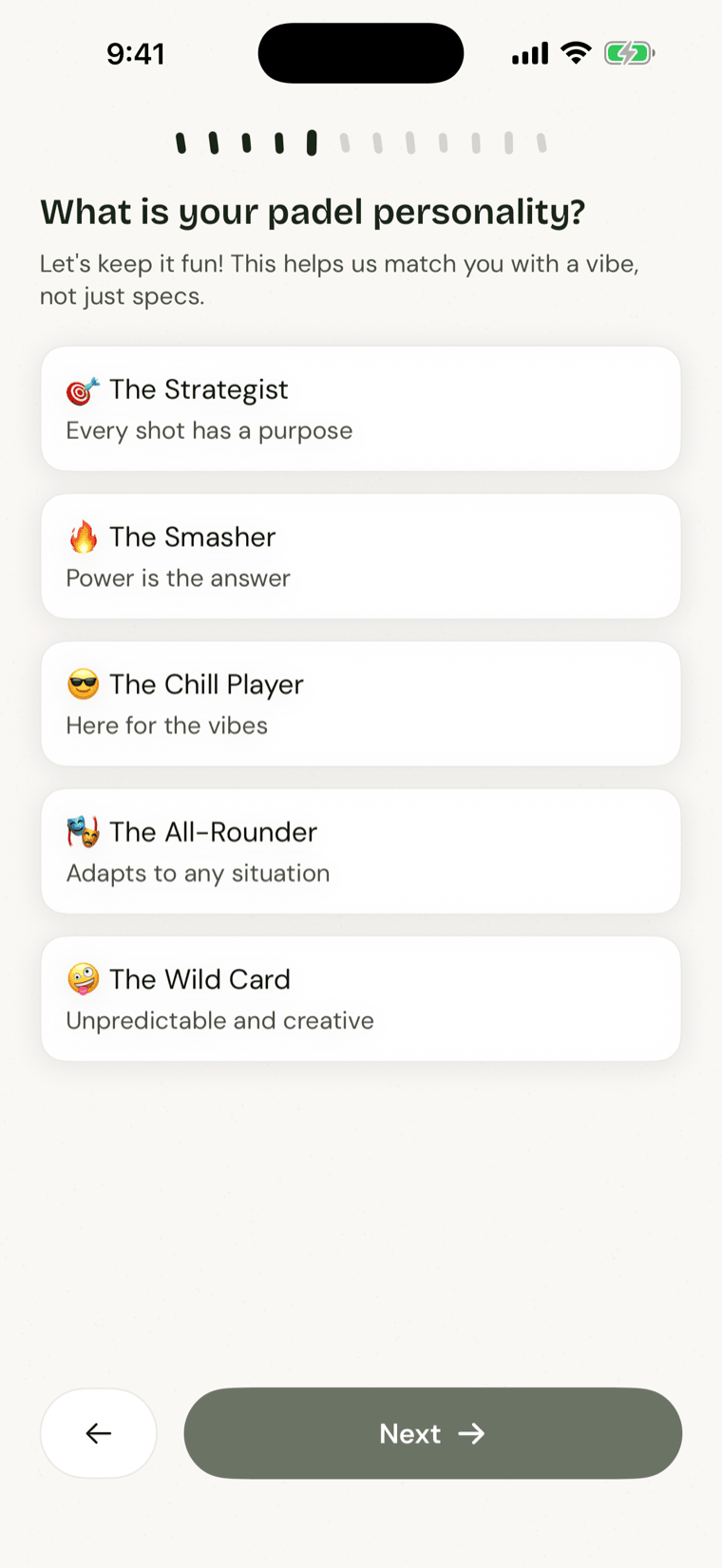
Take the free quiz in the app. We'll match a racket to your game, not the other way around.
Find my racketFree quiz. Sign in with email or Google to get your four picks.

Starvie Arkos 2026 Review
By Andres Jovem · Updated October 19, 2026
The Starvie Arkos is a soft, round, forgiving frame for a new player, built in Spain with a carbon frame and a spin-ready face at entry money, and one you'll outgrow once your swing arrives.
The verdict
The Starvie Arkos is a starter racket that doesn't feel like a starter racket, and that's the whole pitch. It's round, soft-cored, and light in the head, so the sweet spot sits low and central where a new player actually makes contact, and a mishit still drops in the court instead of flying the fence. What lifts it above the usual first-timer box is the build under the paint: a carbon frame and a rough hitting face, the two parts budget rackets cut first. You get them here for entry money.
This is a control-first frame with no interest in power, and it should be judged as one. It rewards the beginner and the improver who wants to learn placement, keep the ball in play, and spare their arm while the technique catches up. If you already generate your own pace and want a racket that punches back, this is not it, and the FAQ below says so plainly. Read the 'who should skip it' list before you spend, because the honest answer is that plenty of players should walk past this one.
The build
A soft core that keeps mishits alive
Starvie builds the Arkos on its S-EVA Flex core, a soft foam that compresses under the ball at contact. That give is the beginner's friend twice over. It widens the margin on an off-center strike, so a ball caught low on the face still leaves with enough on it to clear the net, and it soaks up the shock a stiffer frame fires back up the arm. Play a long session and your elbow notices the difference. The trade is honest: a soft core hands pace back gently, so the ball leaves controlled rather than fast, and you supply the power yourself.
A rough face that grips for spin
The hitting layer is Starvie's X Glass Tech surface with a rough finish, and the texture earns its keep. A gritty face holds the ball for the fraction of a second it sits on the strings, so a brushed shot leaves with rotation instead of leaving flat and lifeless. Most rackets at this money ship a smooth fiberglass face that can't bite the ball at all, which is why spin is usually the first thing a starter frame gives up. Here it survives, and it's the one attacking tool the Arkos offers a learner.
A carbon frame with the weight down low
A carbon fiber frame wraps the round head, and it does the unglamorous job of holding its shape when you catch one off the middle. A softer molded frame twists in the hand on a mishit and sprays the ball; carbon stays firm, so contact stays true. The balance sits low, near your palm, at a listed 367g, which is where the Arkos hides its heft. Held down by your hand, that mass swings quicker than the number suggests, and the head stays out of your way when a volley jumps at you fast.
How it plays
At the net, it comes around in time
For a frame this weight, the Arkos reacts quickly, because the load sits low in your hand rather than out at the tip. A body shot that would turn a head-heavy racket comes back central and firm here, and a volley you meet out in front lands where you aimed it. This is the payoff of the low balance point on the actual shot: the head is never the thing you're fighting. What it won't do is finish a point on its own. The put-away is placement, not pace.
From the baseline, it does the digging for you
Defending deep is where a soft, forgiving frame like this feels most generous. Blocks and lobs travel back deep off a short, easy swing, so you're not muscling the ball out of trouble, you're steering it. A reset drops soft and short when you need it to. The Arkos asks for timing rather than strength here, which is exactly the skill a new player is trying to build, and the racket lets you build it without punishing every rough contact.
On the attack, spin over force
The Arkos has no real power gear, and it doesn't pretend to. What it does have is the rough face, so a brushed bandeja holds its bite and kicks instead of sitting up in the middle of the court for your opponent. The smash is placement and angle, not raw speed, and if you swing harder chasing pace the soft core just absorbs the extra effort and gives little back. Point it, don't pound it. That's the whole game plan this frame is built for.
Comfort and the arm
This is the Arkos at its best. The soft core and the modest, low-slung weight mean contact lands as a cushioned thud, not a jarring sting, so the shock that a stiff, head-heavy racket drives into the elbow and shoulder never really arrives. For a beginner playing two or three times a week while the body adjusts to a new sport, that gentleness is worth more than any spec on the sheet. It's the frame that lets you play the next day.
Who it's for (and who should skip it)
Buy it if
- You're new to padel and want a forgiving, round frame that keeps your mishits in the court while you learn.
- You'd rather keep your first outlay small and still get a carbon frame and a real spin-ready face, not a plain fiberglass box.
- Your arm is sensitive or new to the game, and you want the softest, gentlest contact you can get for the money.
Look elsewhere if
- You already generate your own pace and want a frame that hits through the ball. The Arkos is built to control, not to punch, and it will feel muted to a stronger player.
- You're an improver ready for more bite off the face and a firmer, more explosive core. You'll outgrow this one, and that's by design.
- You want a head-heavy frame for free power on the smash. The weight here sits low for handling, so the overhead is placement, not brute force.
Not sure it's your match? The free 2-minute quiz reads your level, style, and budget and tells you which racket is.
The bottom line
So, if you're just starting and want the most racket per euro that's still kind to your arm, the Starvie Arkos is the easy call: a Spanish-built, carbon-framed, spin-capable frame that forgives while you learn. It's a control-first starter you'll grow out of, and that's the point of a first racket. Not sure it's your match? The free 2-minute quiz reads your level, style, and budget and tells you which racket is yours.
Where to buy
Prices shown in Euro, converted and approximate. You check out in the store's own currency.
Frequently asked
Yes, the Starvie Arkos is one of the better first rackets we stock. It's round and soft-cored at a listed 367g with the balance low in the hand, so the sweet spot sits central, mishits stay in play, and the contact is gentle on a new arm. The carbon frame and rough face are extras most starter frames drop, which is why it's our value pick for a beginner.
The Starvie Arkos is a control racket, firmly. Its soft S-EVA Flex core gives under the ball and hands pace back gently, so you win points on placement and margin rather than raw speed. If you're hunting free power off the face, this round, soft frame will feel muted, and a firmer diamond-shaped racket is the better fit.
The Starvie Arkos pairs an S-EVA Flex soft core with an X Glass Tech face in a rough finish. The soft core cushions contact and keeps off-center hits alive, while the gritty surface grips the ball for spin that smooth budget faces can't produce. A carbon frame wraps the round head to hold its shape on mishits.
No, the Starvie Arkos carries its weight low, near the handle, not in the head. That low balance is why a listed 367g frame swings quicker than the number suggests and reacts on time at the net. It also means the smash relies on your placement and timing rather than free power from a loaded head.
The Starvie Arkos gives you a carbon frame and a spin-ready rough face at entry money, the two parts most budget rackets skip. What a pricier frame adds is a firmer, more explosive core and more power off the face, which a beginner can't use yet and an improver eventually will. Buy the Arkos to learn on; step up when your swing starts asking for more.
The app · free quiz
Not sure which one's you?
Take the free quiz in the app. We'll match a racket to your game, not the other way around.
Find my racketFree quiz. Sign in with email or Google to get your four picks.