Starvie Triton T-One 2027 Review
By Andres Jovem · Updated October 20, 2026
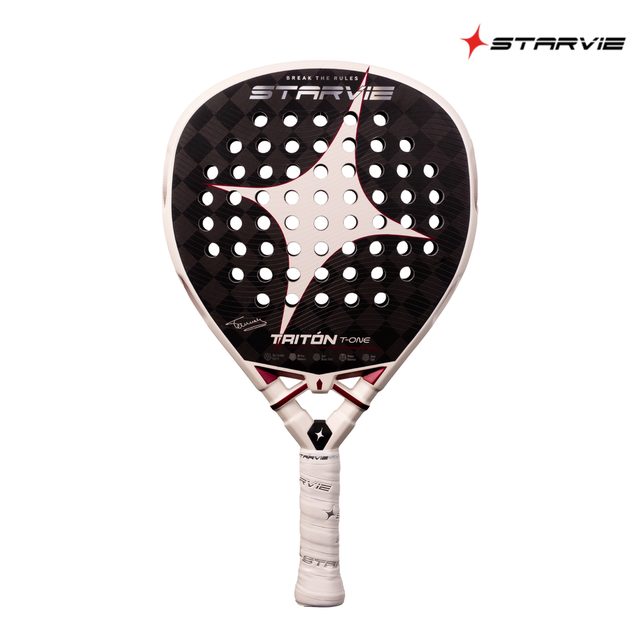
Tamara Icardo's Triton T-One 2027 is a diamond balanced in the middle, with a medium-hard M-EVA core at 347 to 366g: an attacking frame built to be swung through a whole match, for the advanced attacker who ends points and still has to play the long ones.
The verdict
Most diamonds ask you to choose: the mass up top that ends points, or the balance that lets you play the next one. The Triton T-One 2027 is Starvie's answer to that trade, and it is Tamara Icardo's racket for a reason. A diamond head, a medium balance instead of a high one, and a frame that starts at 347g. You get the overhead a diamond promises, and you get it back in your hand fast enough to volley the reply.
This is a 2027 model, on the shelves since September 2026 with Starvie's own figures behind it, and it sits in the brand's Super Pro range, which Starvie aims at professional and advanced women. Treat that label as a warning as much as a promise. The core is medium-hard, the face is 18K carbon, and a strike that wanders low on the diamond's face reports back to your wrist. A player with a grooved swing will love what it does. A player still finding the middle of the racket will find it before the racket forgives them.
At €279 it costs more than most of the women's-line diamonds we cover. Two of our shops have it on the shelf and a third is taking pre-orders, which is what a tour frame in its first season looks like.
The build
M-EVA Balance, the medium-hard core
The core is Starvie's M-EVA Balance, a foam the brand sets on the firm side of medium. Firmer foam compresses less at contact, so more of your swing speed comes out the other side as ball speed, and a flat smash leaves without the dull thud a soft core produces. The cost is feedback: a clean strike feels crisp and a mishit tells you about it. A-Shock in the handle is built to soak up part of that vibration; a third set is where you learn how much.
An 18K carbon hybrid face
The hitting surface is 18K Carbon Hybrid with Starvie's Spin Boost texture. Eighteen thousand fibers to the bundle gives a dense, stiff weave, so the face flexes very little and the ball leaves the way you sent it. The texture does the usual job on a brushed shot: the ball stays on the strings a touch longer and leaves spinning, which is what makes the víbora dip.
A diamond with the balance in the middle
The outline is a new diamond mold for 2027, and the balance is medium. That pairing is the whole idea. A diamond carries its sweet spot up near the tip, where the overhead meets the racket, so the smash has reach and pace. A medium balance keeps the mass from loading the tip, so the racket does not drag when the point turns and you need a quick block. At 347 to 366g you are swinging less than a classic tour diamond carries.
Tri-Force Core, Hexa Cell, Air Booster
The frame carries a three-directional structure, Tri-Force Core, and a hexagonal profile, Hexa Cell, both there to keep it stiff against an off-center strike. Air Booster is a channel through the frame meant to speed the swing. The handgrip is longer than usual, which Starvie says gives a firmer, more precise hold.
How it plays
The overhead, where the diamond earns its price
Give it a lob you can get under and the Triton does what you bought it for. The sweet spot sits high, the firm core fires the ball out, and a smash driven por 4 reaches the back glass and comes out low. Brush the ball instead and the textured face loads it with spin, so the víbora kicks away from the net player rather than sitting up. The medium balance means the second and third overheads of a long point arrive as cleanly as the first, which is the point where a tip-heavy diamond starts to fade.
At the net, quicker than its shape suggests
A diamond with a medium balance volleys better than a diamond with a high one, and this is the shot where you feel the difference most. A block taken out in front goes deep and stays low. One aimed at the backhand hip stays down, because the stiff face adds no lift of its own. A reaction volley off the hip, the one that catches most diamonds lagging, comes through on time more often than not. What the medium balance cannot fix is the small sweet spot: a volley caught low on the face loses pace and floats. Meet the ball early and the racket rewards you. Wait on it and the diamond's geometry shows.
From the back, firm means you do the work
Defending with a medium-hard core is a timing exercise. There is little free rebound off the back glass, so a lob has to be driven to clear the net player and land deep. The upside is control of depth: because the core gives back what you put in, a lob hit with set feet goes as far as you meant it to. A chiquita played late comes off flat and sits up. Where the firm face helps is the fast ball off the side glass: it returns on the same line without you adding anything, so a quick reaction block still lands deep. A player who defends with her legs will be fine; a player who defends with her wrists will be reaching for a softer diamond like the Vertex 05 W Cloud before long.
Wrist and forearm
Firm core, stiff 18K face: the arm note writes itself. A clean strike feels sharp and satisfying, and a mishit sends a jolt into the wrist that a soft frame would swallow. The handle's damping takes some of it. The weight is the saving grace, because 347 to 366g with a medium balance is much easier on the shoulder than a 370g tip-heavy diamond. If your elbow is already a problem, this is not the frame to solve it with. An overgrip and a slightly softer ball for the first week help a wrist that is new to firm frames.
Who it's for (and who should skip it)
Buy it if
- Your points end from the left side and you want a diamond that stays maneuverable through a long rally
- Your swing is settled and you prefer the firm, direct feedback of a tour frame rather than a cushioned one
- You want the racket Tamara Icardo plays in its current season, and you are fine paying first-season money for it
Look elsewhere if
- You are new to the diamond shape: the small, high sweet spot and the firm core will punish a developing swing
- You defend more than you attack, or you count on the back glass for free rebound
- Your wrist or elbow already complains: a soft-cored diamond like the Quantum Soft Women gives you the attack with less of the jolt
Not sure it's your match? The free 2-minute quiz reads your level, style, and budget and tells you which racket is.
The bottom line
A first-season 2027 frame sells at full price, and one of the three shops is still on pre-order. If a diamond balanced in the middle is what your left side needs, the two shops with stock are where to buy it today.
Where to buy
Prices shown in Euro, converted and approximate. You check out in the store's own currency.
Frequently asked
No. The Triton T-One sits in Starvie's Super Pro range, with a diamond head, a medium-hard core and an 18K carbon face at 347 to 366g. A beginner needs a bigger sweet spot and a softer core than that. The Super Pro label is Starvie's own, and it means the frame assumes a swing that is already built. A round frame first; this one later, when the overhead is your best shot.
Power first, with the balance kept in the middle. The diamond shape and the firm core deliver pace on the overhead; the medium balance and the lighter weight keep the racket quick at the net and manageable from the back. It is a versatile attacker rather than a pure finisher.
From €279 at PadelMarket, with PadelShop higher and PadelPROShop taking pre-orders at a shade under PadelMarket's price.
Yes. Starvie builds the Triton T-One 2027 for Tamara Icardo and sells it under her name. It is a 2027-season model that went on sale in September 2026, so the frame you buy is the one on the current tour.
The balance is what changes. A classic tour diamond loads its mass up at the tip for maximum pace on the smash. The Triton T-One keeps the diamond head but balances it in the middle, so it gives up a little raw smash power and gains a lot of speed at the net and on the reset. If your points go long, that trade pays.
An M-EVA Balance core, which Starvie sets medium-hard, under an 18K Carbon Hybrid face with Spin Boost texture. The frame carries Tri-Force Core and Hexa Cell reinforcement, Air Booster channels, A-Shock in the handle, and a longer grip than standard.


The app · free quiz
Not sure which one's you?
Take the free quiz in the app. We'll match a racket to your game, not the other way around.
Find my racketFree quiz. Sign in with email or Google to get your four picks.

Starvie Triton T-One 2027 Review
By Andres Jovem · Updated October 20, 2026
Tamara Icardo's Triton T-One 2027 is a diamond balanced in the middle, with a medium-hard M-EVA core at 347 to 366g: an attacking frame built to be swung through a whole match, for the advanced attacker who ends points and still has to play the long ones.
The verdict
Most diamonds ask you to choose: the mass up top that ends points, or the balance that lets you play the next one. The Triton T-One 2027 is Starvie's answer to that trade, and it is Tamara Icardo's racket for a reason. A diamond head, a medium balance instead of a high one, and a frame that starts at 347g. You get the overhead a diamond promises, and you get it back in your hand fast enough to volley the reply.
This is a 2027 model, on the shelves since September 2026 with Starvie's own figures behind it, and it sits in the brand's Super Pro range, which Starvie aims at professional and advanced women. Treat that label as a warning as much as a promise. The core is medium-hard, the face is 18K carbon, and a strike that wanders low on the diamond's face reports back to your wrist. A player with a grooved swing will love what it does. A player still finding the middle of the racket will find it before the racket forgives them.
At €279 it costs more than most of the women's-line diamonds we cover. Two of our shops have it on the shelf and a third is taking pre-orders, which is what a tour frame in its first season looks like.
The build
M-EVA Balance, the medium-hard core
The core is Starvie's M-EVA Balance, a foam the brand sets on the firm side of medium. Firmer foam compresses less at contact, so more of your swing speed comes out the other side as ball speed, and a flat smash leaves without the dull thud a soft core produces. The cost is feedback: a clean strike feels crisp and a mishit tells you about it. A-Shock in the handle is built to soak up part of that vibration; a third set is where you learn how much.
An 18K carbon hybrid face
The hitting surface is 18K Carbon Hybrid with Starvie's Spin Boost texture. Eighteen thousand fibers to the bundle gives a dense, stiff weave, so the face flexes very little and the ball leaves the way you sent it. The texture does the usual job on a brushed shot: the ball stays on the strings a touch longer and leaves spinning, which is what makes the víbora dip.
A diamond with the balance in the middle
The outline is a new diamond mold for 2027, and the balance is medium. That pairing is the whole idea. A diamond carries its sweet spot up near the tip, where the overhead meets the racket, so the smash has reach and pace. A medium balance keeps the mass from loading the tip, so the racket does not drag when the point turns and you need a quick block. At 347 to 366g you are swinging less than a classic tour diamond carries.
Tri-Force Core, Hexa Cell, Air Booster
The frame carries a three-directional structure, Tri-Force Core, and a hexagonal profile, Hexa Cell, both there to keep it stiff against an off-center strike. Air Booster is a channel through the frame meant to speed the swing. The handgrip is longer than usual, which Starvie says gives a firmer, more precise hold.
How it plays
The overhead, where the diamond earns its price
Give it a lob you can get under and the Triton does what you bought it for. The sweet spot sits high, the firm core fires the ball out, and a smash driven por 4 reaches the back glass and comes out low. Brush the ball instead and the textured face loads it with spin, so the víbora kicks away from the net player rather than sitting up. The medium balance means the second and third overheads of a long point arrive as cleanly as the first, which is the point where a tip-heavy diamond starts to fade.
At the net, quicker than its shape suggests
A diamond with a medium balance volleys better than a diamond with a high one, and this is the shot where you feel the difference most. A block taken out in front goes deep and stays low. One aimed at the backhand hip stays down, because the stiff face adds no lift of its own. A reaction volley off the hip, the one that catches most diamonds lagging, comes through on time more often than not. What the medium balance cannot fix is the small sweet spot: a volley caught low on the face loses pace and floats. Meet the ball early and the racket rewards you. Wait on it and the diamond's geometry shows.
From the back, firm means you do the work
Defending with a medium-hard core is a timing exercise. There is little free rebound off the back glass, so a lob has to be driven to clear the net player and land deep. The upside is control of depth: because the core gives back what you put in, a lob hit with set feet goes as far as you meant it to. A chiquita played late comes off flat and sits up. Where the firm face helps is the fast ball off the side glass: it returns on the same line without you adding anything, so a quick reaction block still lands deep. A player who defends with her legs will be fine; a player who defends with her wrists will be reaching for a softer diamond like the Vertex 05 W Cloud before long.
Wrist and forearm
Firm core, stiff 18K face: the arm note writes itself. A clean strike feels sharp and satisfying, and a mishit sends a jolt into the wrist that a soft frame would swallow. The handle's damping takes some of it. The weight is the saving grace, because 347 to 366g with a medium balance is much easier on the shoulder than a 370g tip-heavy diamond. If your elbow is already a problem, this is not the frame to solve it with. An overgrip and a slightly softer ball for the first week help a wrist that is new to firm frames.
Who it's for (and who should skip it)
Buy it if
- Your points end from the left side and you want a diamond that stays maneuverable through a long rally
- Your swing is settled and you prefer the firm, direct feedback of a tour frame rather than a cushioned one
- You want the racket Tamara Icardo plays in its current season, and you are fine paying first-season money for it
Look elsewhere if
- You are new to the diamond shape: the small, high sweet spot and the firm core will punish a developing swing
- You defend more than you attack, or you count on the back glass for free rebound
- Your wrist or elbow already complains: a soft-cored diamond like the Quantum Soft Women gives you the attack with less of the jolt
Not sure it's your match? The free 2-minute quiz reads your level, style, and budget and tells you which racket is.
The bottom line
A first-season 2027 frame sells at full price, and one of the three shops is still on pre-order. If a diamond balanced in the middle is what your left side needs, the two shops with stock are where to buy it today.
Where to buy
Prices shown in Euro, converted and approximate. You check out in the store's own currency.
Frequently asked
No. The Triton T-One sits in Starvie's Super Pro range, with a diamond head, a medium-hard core and an 18K carbon face at 347 to 366g. A beginner needs a bigger sweet spot and a softer core than that. The Super Pro label is Starvie's own, and it means the frame assumes a swing that is already built. A round frame first; this one later, when the overhead is your best shot.
Power first, with the balance kept in the middle. The diamond shape and the firm core deliver pace on the overhead; the medium balance and the lighter weight keep the racket quick at the net and manageable from the back. It is a versatile attacker rather than a pure finisher.
From €279 at PadelMarket, with PadelShop higher and PadelPROShop taking pre-orders at a shade under PadelMarket's price.
Yes. Starvie builds the Triton T-One 2027 for Tamara Icardo and sells it under her name. It is a 2027-season model that went on sale in September 2026, so the frame you buy is the one on the current tour.
The balance is what changes. A classic tour diamond loads its mass up at the tip for maximum pace on the smash. The Triton T-One keeps the diamond head but balances it in the middle, so it gives up a little raw smash power and gains a lot of speed at the net and on the reset. If your points go long, that trade pays.
An M-EVA Balance core, which Starvie sets medium-hard, under an 18K Carbon Hybrid face with Spin Boost texture. The frame carries Tri-Force Core and Hexa Cell reinforcement, Air Booster channels, A-Shock in the handle, and a longer grip than standard.
The app · free quiz
Not sure which one's you?
Take the free quiz in the app. We'll match a racket to your game, not the other way around.
Find my racketFree quiz. Sign in with email or Google to get your four picks.