Joma Hyper Pro HRD 2026 Review
By Andres Jovem · Updated October 20, 2026
A hard-cored, head-heavy 12K carbon diamond at a mid-shelf price: the Joma Hyper Pro HRD pays a grooved attacker back in full and gives a developing one nothing to hide behind.
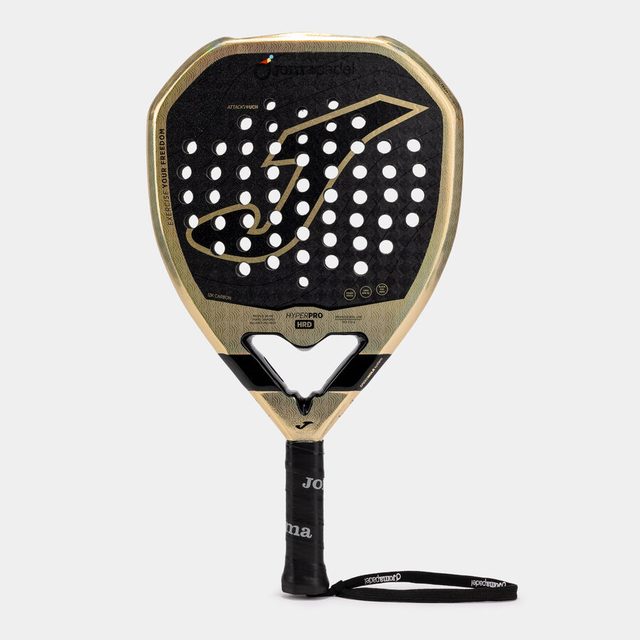
The verdict
Hard cores usually come with flagship prices. Joma's doesn't. The Hyper Pro HRD puts a high-density Black EVA core under a 12K carbon face in a head-heavy diamond and costs from around €144.95, which is mid-shelf money for a hard-cored 12K diamond. It is an advanced racket built for power, and both words are earned. This is a finisher's racket for the player whose overhead already wins points and who wants a firm, direct strike without top-shelf money.
The bill for that directness is paid on every mishit. A dense core and a stiff face cushion almost nothing, so an off-center hit reports straight to the wrist, and the head-heavy balance makes a late block hard to time. If your smash is still a work in progress, this frame will not help it along; it will tell you, bluntly, each time you get it wrong. Settled attackers will read that as a fair deal. Everyone else should keep reading, because the skip list below is the half of this review that matters.
The build
A high-density core that keeps a flat smash flat
The HRD in the name belongs to the foam. Black EVA HRD is Joma's high-density core. It is firm and stable, which for you means a ball that leaves fast and a frame that does not twist. Foam this dense gives almost nothing at contact, so the speed you put into a swing leaves with the ball instead of sinking into the racket, and a flat hit stays flat instead of ballooning. The same density is why so little of the hit is absorbed before it reaches your hand: feedback is immediate and, on a shank, unkind.
A 12K carbon face with a molded grit
Over the core sits a 12K carbon face, a stiff weave that fires the ball off the surface without delay. Its 3D rough finish is molded into the skin, and it holds a brushed ball just long enough to put rotation on it. That rotation is what keeps a víbora down after the side wall instead of floating up for the return. On a frame this stiff, spin is the one form of margin on offer.
A head-heavy diamond in a Dualtech carbon frame
The head is a diamond, the sweet spot is pushed high, and the balance sits high to match, so the mass is out toward the tip where an overhead wants it. The frame repeats the 12K carbon in Joma's Dualtech structure, built for stiffness and durability, and the profile is 38 mm. Aerobump and Speed Hole System are also on the sheet, with no stated job. Weight runs 355 to 365g, moderate for a diamond. The high balance makes it feel heavier through the swing than the number suggests, because the mass sits out near the tip.
How it plays
Overhead, what comes back matches what you put in
Own it for the overhead. Take the ball above your head with your feet set and the smash goes out at the speed you swung, heavy and steep. The back glass sends that ball past the defender before they have turned. The víbora is its best trick: a brushed swing sends the ball skidding low off the side wall, and the bandeja drops in controlled when you want to reset instead of finish. Let the ball fall below shoulder height before you hit it and the frame has nothing to add; the sweet spot sits high and rewards only the player who goes up to meet it.
At the net, the ball wants to be above the tape
Volleys want the ball above the net tape. Take it there and a short punch goes through the pair, with a contact that tells you at once whether you found the middle. Let it drop to your hip and the head, carrying most of its weight at the tip, arrives late; the ball sprays and the handle stings. There is no slow version of this racket at the net. Early hands or nothing.
Defending, you take the pace off yourself
Pinned on the back glass, this frame adds nothing to your defense. Blocks leave quick, so a reset needs soft, early hands and a short swing, and a hurried lob sails long because the face gives you no slow bounce to borrow. Good attackers defend with the Hyper Pro HRD by shortening everything and trusting their timing. Players who live behind the service line will find it a long evening.
Your wrist and elbow keep score
The arm note matters more here than on most rackets. A dense core, a stiff face, and a head-heavy balance hand more of each hit back to the wrist and elbow than any soft-cored frame we review. A thicker overgrip will not change the physics. Find the center with a settled swing and the contact feels electric, and the ball leaves fast. A tired arm in the third set, or an arm with a history of trouble, will feel every mishit the next day. If that is you, our tennis-elbow guide has frames built the opposite way.
Who it's for (and who should skip it)
Buy it if
- Your overhead already wins points and you want a firm, direct strike without a flagship price
- You have settled on a hard core and a diamond, and you take the ball high with your feet set
- You attack from the left side and would rather defend with a short swing than borrow rebound from a soft frame
Look elsewhere if
- Your smash is still developing: this frame gives a learning overhead no margin, and an intermediate-friendly diamond will teach the shape more kindly
- Your elbow or wrist complains after a long match: the dense core and stiff face hand more of each hit back than any soft-cored frame we review
- You win points from deep: there is no soft bounce here, and every reset comes from your own hands
Not sure it's your match? The free 2-minute quiz reads your level, style, and budget and tells you which racket is.
The bottom line
The price is the easy part. The bill arrives on the mishits, and only an overhead that already wins points can afford to pay it.
Where to buy
Prices shown in Euro, converted and approximate. You check out in the store's own currency.
Frequently asked
No, because the Hyper Pro HRD is an advanced attacking racket: a diamond of 355 to 365g with a high balance, a high-density Black EVA core, and a stiff 12K carbon face. A beginner will mishit it, feel each one in the elbow, and get no help on the lob. A round, soft-cored frame will let you learn the game without paying for every miss. This one is for later, once your overhead is already winning points.
Power, no question. The Hyper Pro HRD's dense core turns swing speed into ball speed. The diamond head puts the sweet spot high for the overhead, and the head-heavy balance puts the mass where a smash wants it. The 3D rough face gives you spin on brushed shots, but nothing about this frame is built for placement from the back.
From around €144.95 for the Hyper Pro HRD, down from a list price of €199.95 at that shop, which is cheap for a 12K carbon diamond with a hard core. A second shop carries a signature edition listed 5g heavier at a higher price. Which shop is cheapest on the day is in the block above.
Mostly price: the Hyper Pro HRD is a hard-cored 12K carbon diamond from around €144.95; the Bullpadel Vertex and Nox AT10 attacking diamonds sit above that. Read those reviews for their builds; the saving here buys a simpler, stiffer frame, and the saving is the point if you already own the technique.
Black EVA HRD under 12K carbon: the Hyper Pro HRD runs Joma's high-density foam under a 12K carbon face with a molded 3D rough finish, in a 12K carbon frame built on Joma's Dualtech structure. The dense foam keeps the strike fast and flat; the stiff carbon face fires the ball without delay; the rough surface grips a brushed shot for spin. Together they make a racket that hides nothing from the hand. If you like the recipe but want some of the sting taken out, the same brand's softer frames trade the HRD core for a flexing one. The Valkiria Flex we review is the opposite end of the Joma range.
The left side, because the Hyper Pro HRD is a head-heavy diamond with the sweet spot pushed high. That is the geometry a left-side finisher uses to end points overhead. Its stiff, direct contact punishes the reactive, defensive volleying a right-sider does more of. A right-side player who already attacks a lot can run it, but a frame with a lower balance and a wider sweet spot will suit the role's resets and blocks better.

The app · free quiz
Not sure which one's you?
Take the free quiz in the app. We'll match a racket to your game, not the other way around.
Find my racketFree quiz. Sign in with email or Google to get your four picks.

Joma Hyper Pro HRD 2026 Review
By Andres Jovem · Updated October 20, 2026
A hard-cored, head-heavy 12K carbon diamond at a mid-shelf price: the Joma Hyper Pro HRD pays a grooved attacker back in full and gives a developing one nothing to hide behind.
The verdict
Hard cores usually come with flagship prices. Joma's doesn't. The Hyper Pro HRD puts a high-density Black EVA core under a 12K carbon face in a head-heavy diamond and costs from around €144.95, which is mid-shelf money for a hard-cored 12K diamond. It is an advanced racket built for power, and both words are earned. This is a finisher's racket for the player whose overhead already wins points and who wants a firm, direct strike without top-shelf money.
The bill for that directness is paid on every mishit. A dense core and a stiff face cushion almost nothing, so an off-center hit reports straight to the wrist, and the head-heavy balance makes a late block hard to time. If your smash is still a work in progress, this frame will not help it along; it will tell you, bluntly, each time you get it wrong. Settled attackers will read that as a fair deal. Everyone else should keep reading, because the skip list below is the half of this review that matters.
The build
A high-density core that keeps a flat smash flat
The HRD in the name belongs to the foam. Black EVA HRD is Joma's high-density core. It is firm and stable, which for you means a ball that leaves fast and a frame that does not twist. Foam this dense gives almost nothing at contact, so the speed you put into a swing leaves with the ball instead of sinking into the racket, and a flat hit stays flat instead of ballooning. The same density is why so little of the hit is absorbed before it reaches your hand: feedback is immediate and, on a shank, unkind.
A 12K carbon face with a molded grit
Over the core sits a 12K carbon face, a stiff weave that fires the ball off the surface without delay. Its 3D rough finish is molded into the skin, and it holds a brushed ball just long enough to put rotation on it. That rotation is what keeps a víbora down after the side wall instead of floating up for the return. On a frame this stiff, spin is the one form of margin on offer.
A head-heavy diamond in a Dualtech carbon frame
The head is a diamond, the sweet spot is pushed high, and the balance sits high to match, so the mass is out toward the tip where an overhead wants it. The frame repeats the 12K carbon in Joma's Dualtech structure, built for stiffness and durability, and the profile is 38 mm. Aerobump and Speed Hole System are also on the sheet, with no stated job. Weight runs 355 to 365g, moderate for a diamond. The high balance makes it feel heavier through the swing than the number suggests, because the mass sits out near the tip.
How it plays
Overhead, what comes back matches what you put in
Own it for the overhead. Take the ball above your head with your feet set and the smash goes out at the speed you swung, heavy and steep. The back glass sends that ball past the defender before they have turned. The víbora is its best trick: a brushed swing sends the ball skidding low off the side wall, and the bandeja drops in controlled when you want to reset instead of finish. Let the ball fall below shoulder height before you hit it and the frame has nothing to add; the sweet spot sits high and rewards only the player who goes up to meet it.
At the net, the ball wants to be above the tape
Volleys want the ball above the net tape. Take it there and a short punch goes through the pair, with a contact that tells you at once whether you found the middle. Let it drop to your hip and the head, carrying most of its weight at the tip, arrives late; the ball sprays and the handle stings. There is no slow version of this racket at the net. Early hands or nothing.
Defending, you take the pace off yourself
Pinned on the back glass, this frame adds nothing to your defense. Blocks leave quick, so a reset needs soft, early hands and a short swing, and a hurried lob sails long because the face gives you no slow bounce to borrow. Good attackers defend with the Hyper Pro HRD by shortening everything and trusting their timing. Players who live behind the service line will find it a long evening.
Your wrist and elbow keep score
The arm note matters more here than on most rackets. A dense core, a stiff face, and a head-heavy balance hand more of each hit back to the wrist and elbow than any soft-cored frame we review. A thicker overgrip will not change the physics. Find the center with a settled swing and the contact feels electric, and the ball leaves fast. A tired arm in the third set, or an arm with a history of trouble, will feel every mishit the next day. If that is you, our tennis-elbow guide has frames built the opposite way.
Who it's for (and who should skip it)
Buy it if
- Your overhead already wins points and you want a firm, direct strike without a flagship price
- You have settled on a hard core and a diamond, and you take the ball high with your feet set
- You attack from the left side and would rather defend with a short swing than borrow rebound from a soft frame
Look elsewhere if
- Your smash is still developing: this frame gives a learning overhead no margin, and an intermediate-friendly diamond will teach the shape more kindly
- Your elbow or wrist complains after a long match: the dense core and stiff face hand more of each hit back than any soft-cored frame we review
- You win points from deep: there is no soft bounce here, and every reset comes from your own hands
Not sure it's your match? The free 2-minute quiz reads your level, style, and budget and tells you which racket is.
The bottom line
The price is the easy part. The bill arrives on the mishits, and only an overhead that already wins points can afford to pay it.
Where to buy
Prices shown in Euro, converted and approximate. You check out in the store's own currency.
Frequently asked
No, because the Hyper Pro HRD is an advanced attacking racket: a diamond of 355 to 365g with a high balance, a high-density Black EVA core, and a stiff 12K carbon face. A beginner will mishit it, feel each one in the elbow, and get no help on the lob. A round, soft-cored frame will let you learn the game without paying for every miss. This one is for later, once your overhead is already winning points.
Power, no question. The Hyper Pro HRD's dense core turns swing speed into ball speed. The diamond head puts the sweet spot high for the overhead, and the head-heavy balance puts the mass where a smash wants it. The 3D rough face gives you spin on brushed shots, but nothing about this frame is built for placement from the back.
From around €144.95 for the Hyper Pro HRD, down from a list price of €199.95 at that shop, which is cheap for a 12K carbon diamond with a hard core. A second shop carries a signature edition listed 5g heavier at a higher price. Which shop is cheapest on the day is in the block above.
Mostly price: the Hyper Pro HRD is a hard-cored 12K carbon diamond from around €144.95; the Bullpadel Vertex and Nox AT10 attacking diamonds sit above that. Read those reviews for their builds; the saving here buys a simpler, stiffer frame, and the saving is the point if you already own the technique.
Black EVA HRD under 12K carbon: the Hyper Pro HRD runs Joma's high-density foam under a 12K carbon face with a molded 3D rough finish, in a 12K carbon frame built on Joma's Dualtech structure. The dense foam keeps the strike fast and flat; the stiff carbon face fires the ball without delay; the rough surface grips a brushed shot for spin. Together they make a racket that hides nothing from the hand. If you like the recipe but want some of the sting taken out, the same brand's softer frames trade the HRD core for a flexing one. The Valkiria Flex we review is the opposite end of the Joma range.
The left side, because the Hyper Pro HRD is a head-heavy diamond with the sweet spot pushed high. That is the geometry a left-side finisher uses to end points overhead. Its stiff, direct contact punishes the reactive, defensive volleying a right-sider does more of. A right-side player who already attacks a lot can run it, but a frame with a lower balance and a wider sweet spot will suit the role's resets and blocks better.
The app · free quiz
Not sure which one's you?
Take the free quiz in the app. We'll match a racket to your game, not the other way around.
Find my racketFree quiz. Sign in with email or Google to get your four picks.