Nox EA10 Ventus Hybrid 12K Xtreme 2026 Review
By Andres Jovem · Updated October 19, 2026
An advanced all-court teardrop that shifts from defense to finish inside one point, if you spin your overheads rather than flatten them.
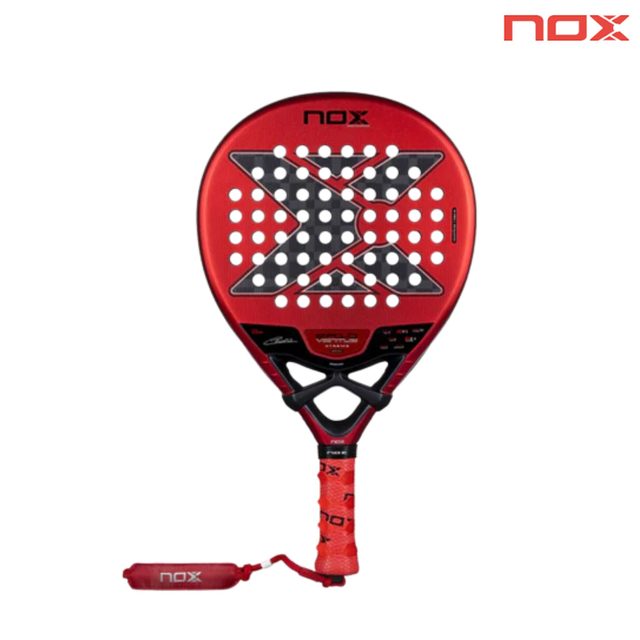
The verdict
The Nox EA10 Ventus Hybrid 12K Xtreme is a switch-hitter, and that is the whole idea. It is a teardrop tuned for the player who has to defend one ball and put away the next, with a layered core that softens for the block and firms up for the swing. Medium balance keeps it honest through the middle of the point, quick enough in the hands to volley and stable enough behind an overhead to matter.
This is a frame for an advanced player who moves through the court rather than camping in one spot. It asks for a brushing swing on the smash and pays back a spin player who works the ball. If you flatten everything and want a stick that bombs the ball flat off the back wall, a dedicated power frame like the Adidas Metalbone will give you a higher raw ceiling than this one chases. If you cover the whole court and win points from anywhere on it, read on.
The build
A core built from layers, not one block
The core here is not one foam but several, an MLD Black EVA stack that Nox layers at different densities through the racket. The upshot is that a soft block sinks into the gentler center for a wider margin, while a committed swing presses down into the firmer material and gets pace back. A single-density core makes you pick a lane, soft for comfort or hard for pace. This one lets the shot decide, which is exactly what an all-court game needs. The tradeoff is that you have to swing with intent to reach the firm side, and a lazy, arm-only stroke leaves the pace sitting in the foam.
A gritty hitting surface tuned for rotation
The hitting layer is a 12K Xtrem Carbon Fiber weave with a coarse, sandy finish. The weave is rough enough to feel under your fingertips, and that grit is what lets a brushing swing load the ball with spin rather than skidding it flat. On the bandeja and víbora that grip is the difference between a shot that dips into the corner and one that floats up to be attacked. Spin is the payoff this face is built to give, and it wants you to lift up the back of the ball to collect it.
A carbon teardrop balanced through the middle
The mold is a teardrop in a full carbon frame, and the mass sits at a medium balance rather than stacked in the head. That placement is what keeps it usable at both ends of the court. It carries enough weight up top to plant behind a smash without feeling like a club you have to haul back to the net. At 367g it is a full-weight advanced frame, so it holds its line on contact, but a medium balance keeps the head from lagging when a ball jumps at you fast.
How it plays
In the transitions
This is where the racket lives. Caught between the net and the baseline with a low ball at your feet, you can cushion it back deep and keep walking in, then take the next one out of the air with a firm punch. The face stays composed on a half-volley when you are still moving, so the awkward in-between ball that usually forces a defensive lob becomes a shot you can place. Few frames make the messy middle of the court feel this calm.
At the net
Up close it reacts quickly and settles fast for the counter. A volley leaves with a clean, controlled snap when you meet it in front, and the frame recovers to your ready position without dragging your arm around. Get late and rushed and it will still block the ball back, but the crisp put-away you wanted turns into a safe reset instead. It rewards early hands and hunts the counter, not a passive wall.
On the attack
The overhead is a spin shot on this frame, not a flat bomb. Come up and across the ball and the smash lands with a bite that skids low and jumps sideways off the surface, the sort of bounce that has a returner lunging late. Drive flat and straight through instead and that bite disappears, so the ball goes deep but sits up tame and hittable. A player who already finishes with a víbora and a topspin smash will feel at home in a swing or two. A pure power hitter will feel the frame asking for a stroke they do not play.
Comfort and the arm
An edge-of-face block that catches you off center does not punch straight back through the wrist; the sting arrives at your arm muffled and blunted instead of sharp. This is a kinder frame than a stiff single-density power racket. It is still a 367g advanced teardrop, though, and a full attacking swing puts a sharp jolt up through the forearm on every clean contact. If your elbow is already tender, the weight and the pace it delivers will find it late in a long match, and the weight is the weight, no accessory softens that.
Who it's for (and who should skip it)
Buy it if
- You play the whole court and want one frame that defends a ball and finishes the next without you switching gears in your head.
- You put topspin on your overheads and work the bandeja and víbora, so the rough face and the firm layers pay you back.
- You are an advanced player with sound timing who wants a full-weight teardrop that still moves quickly at the net.
Look elsewhere if
- You are a flat power hitter who drives straight through the smash. The spin-first face and layered core reward brushing, not blasting, and a dedicated power frame will hand you more free pace.
- Your arm tires or your elbow flares late in a match. A 367g advanced frame delivering this much pace asks a lot of the forearm, and the softer core only cushions so much.
- You are still building your swing. This frame wants you to commit to reach its firm side, and a beginner will leave the pace stuck in the foam and fight the weight.
Not sure it's your match? The free 2-minute quiz reads your level, style, and budget and tells you which racket is.
The bottom line
There is no best racket, only the best racket for how you play, and this one is for the mover who wins points from every corner rather than one spot. If that is your game and you spin your overheads, the EA10 Ventus Hybrid rewards it. If you want to be sure it fits your level and budget before you spend, the free 2-minute quiz will tell you in plain terms.
Where to buy
Prices shown in Euro, converted and approximate. You check out in the store's own currency.
Frequently asked
No. The EA10 Ventus Hybrid 12K Xtreme is a 367g advanced teardrop that only gives its pace back to a committed, well-timed swing, so a beginner will wrestle the weight and leave the power sitting in the core. A round, soft frame around 355g will teach you more and spare your arm. Come back to this one once your strokes are grooved and you spin your overheads.
Call it a balanced all-court frame that leans on adaptability rather than raw power. The multi-density MLD Black EVA core softens for a controlled block and firms up for an attacking swing, and the medium balance keeps it steady at the net instead of stacking mass in the head. You get pace when you swing for it, control when you throttle back, which is the point of the hybrid.
The core is an MLD Black EVA foam layered in several densities, so the racket plays soft on a gentle touch and firm under a full swing. Covering it is a 12K Xtrem Carbon Fiber face with a rough finish that grips the ball for spin on the bandeja and víbora. The frame around both is full carbon in a teardrop mold.
The EA10 Ventus Hybrid is built for the advanced all-court player who covers the whole court and changes pace inside a single point. Defenders who never leave the baseline and flat power hitters who only want to bomb the smash are both better served elsewhere. The best fit is a spin-oriented player with the timing to work a ball from defense into attack.
Against the Vertex 05, this frame gives up a slice of raw punch and gets back more range across the court in return. Where a top-shelf diamond is built to finish, this teardrop is built to switch gears, defending one ball and attacking the next, and it costs less to get there. Pick it if you value adaptability over an out-and-out power ceiling. Not sure which is your match? The free 2-minute quiz reads your level, style, and budget and tells you.


The app · free quiz
Not sure which one's you?
Take the free quiz in the app. We'll match a racket to your game, not the other way around.
Find my racketFree quiz. Sign in with email or Google to get your four picks.

Nox EA10 Ventus Hybrid 12K Xtreme 2026 Review
By Andres Jovem · Updated October 19, 2026
An advanced all-court teardrop that shifts from defense to finish inside one point, if you spin your overheads rather than flatten them.
The verdict
The Nox EA10 Ventus Hybrid 12K Xtreme is a switch-hitter, and that is the whole idea. It is a teardrop tuned for the player who has to defend one ball and put away the next, with a layered core that softens for the block and firms up for the swing. Medium balance keeps it honest through the middle of the point, quick enough in the hands to volley and stable enough behind an overhead to matter.
This is a frame for an advanced player who moves through the court rather than camping in one spot. It asks for a brushing swing on the smash and pays back a spin player who works the ball. If you flatten everything and want a stick that bombs the ball flat off the back wall, a dedicated power frame like the Adidas Metalbone will give you a higher raw ceiling than this one chases. If you cover the whole court and win points from anywhere on it, read on.
The build
A core built from layers, not one block
The core here is not one foam but several, an MLD Black EVA stack that Nox layers at different densities through the racket. The upshot is that a soft block sinks into the gentler center for a wider margin, while a committed swing presses down into the firmer material and gets pace back. A single-density core makes you pick a lane, soft for comfort or hard for pace. This one lets the shot decide, which is exactly what an all-court game needs. The tradeoff is that you have to swing with intent to reach the firm side, and a lazy, arm-only stroke leaves the pace sitting in the foam.
A gritty hitting surface tuned for rotation
The hitting layer is a 12K Xtrem Carbon Fiber weave with a coarse, sandy finish. The weave is rough enough to feel under your fingertips, and that grit is what lets a brushing swing load the ball with spin rather than skidding it flat. On the bandeja and víbora that grip is the difference between a shot that dips into the corner and one that floats up to be attacked. Spin is the payoff this face is built to give, and it wants you to lift up the back of the ball to collect it.
A carbon teardrop balanced through the middle
The mold is a teardrop in a full carbon frame, and the mass sits at a medium balance rather than stacked in the head. That placement is what keeps it usable at both ends of the court. It carries enough weight up top to plant behind a smash without feeling like a club you have to haul back to the net. At 367g it is a full-weight advanced frame, so it holds its line on contact, but a medium balance keeps the head from lagging when a ball jumps at you fast.
How it plays
In the transitions
This is where the racket lives. Caught between the net and the baseline with a low ball at your feet, you can cushion it back deep and keep walking in, then take the next one out of the air with a firm punch. The face stays composed on a half-volley when you are still moving, so the awkward in-between ball that usually forces a defensive lob becomes a shot you can place. Few frames make the messy middle of the court feel this calm.
At the net
Up close it reacts quickly and settles fast for the counter. A volley leaves with a clean, controlled snap when you meet it in front, and the frame recovers to your ready position without dragging your arm around. Get late and rushed and it will still block the ball back, but the crisp put-away you wanted turns into a safe reset instead. It rewards early hands and hunts the counter, not a passive wall.
On the attack
The overhead is a spin shot on this frame, not a flat bomb. Come up and across the ball and the smash lands with a bite that skids low and jumps sideways off the surface, the sort of bounce that has a returner lunging late. Drive flat and straight through instead and that bite disappears, so the ball goes deep but sits up tame and hittable. A player who already finishes with a víbora and a topspin smash will feel at home in a swing or two. A pure power hitter will feel the frame asking for a stroke they do not play.
Comfort and the arm
An edge-of-face block that catches you off center does not punch straight back through the wrist; the sting arrives at your arm muffled and blunted instead of sharp. This is a kinder frame than a stiff single-density power racket. It is still a 367g advanced teardrop, though, and a full attacking swing puts a sharp jolt up through the forearm on every clean contact. If your elbow is already tender, the weight and the pace it delivers will find it late in a long match, and the weight is the weight, no accessory softens that.
Who it's for (and who should skip it)
Buy it if
- You play the whole court and want one frame that defends a ball and finishes the next without you switching gears in your head.
- You put topspin on your overheads and work the bandeja and víbora, so the rough face and the firm layers pay you back.
- You are an advanced player with sound timing who wants a full-weight teardrop that still moves quickly at the net.
Look elsewhere if
- You are a flat power hitter who drives straight through the smash. The spin-first face and layered core reward brushing, not blasting, and a dedicated power frame will hand you more free pace.
- Your arm tires or your elbow flares late in a match. A 367g advanced frame delivering this much pace asks a lot of the forearm, and the softer core only cushions so much.
- You are still building your swing. This frame wants you to commit to reach its firm side, and a beginner will leave the pace stuck in the foam and fight the weight.
Not sure it's your match? The free 2-minute quiz reads your level, style, and budget and tells you which racket is.
The bottom line
There is no best racket, only the best racket for how you play, and this one is for the mover who wins points from every corner rather than one spot. If that is your game and you spin your overheads, the EA10 Ventus Hybrid rewards it. If you want to be sure it fits your level and budget before you spend, the free 2-minute quiz will tell you in plain terms.
Where to buy
Prices shown in Euro, converted and approximate. You check out in the store's own currency.
Frequently asked
No. The EA10 Ventus Hybrid 12K Xtreme is a 367g advanced teardrop that only gives its pace back to a committed, well-timed swing, so a beginner will wrestle the weight and leave the power sitting in the core. A round, soft frame around 355g will teach you more and spare your arm. Come back to this one once your strokes are grooved and you spin your overheads.
Call it a balanced all-court frame that leans on adaptability rather than raw power. The multi-density MLD Black EVA core softens for a controlled block and firms up for an attacking swing, and the medium balance keeps it steady at the net instead of stacking mass in the head. You get pace when you swing for it, control when you throttle back, which is the point of the hybrid.
The core is an MLD Black EVA foam layered in several densities, so the racket plays soft on a gentle touch and firm under a full swing. Covering it is a 12K Xtrem Carbon Fiber face with a rough finish that grips the ball for spin on the bandeja and víbora. The frame around both is full carbon in a teardrop mold.
The EA10 Ventus Hybrid is built for the advanced all-court player who covers the whole court and changes pace inside a single point. Defenders who never leave the baseline and flat power hitters who only want to bomb the smash are both better served elsewhere. The best fit is a spin-oriented player with the timing to work a ball from defense into attack.
Against the Vertex 05, this frame gives up a slice of raw punch and gets back more range across the court in return. Where a top-shelf diamond is built to finish, this teardrop is built to switch gears, defending one ball and attacking the next, and it costs less to get there. Pick it if you value adaptability over an out-and-out power ceiling. Not sure which is your match? The free 2-minute quiz reads your level, style, and budget and tells you.
The app · free quiz
Not sure which one's you?
Take the free quiz in the app. We'll match a racket to your game, not the other way around.
Find my racketFree quiz. Sign in with email or Google to get your four picks.